What CORPUS Is — and What It Isn't
Public beta
CORPUS is being built in the open. Some of what you read here is live, some is still design intent — expect it to evolve.
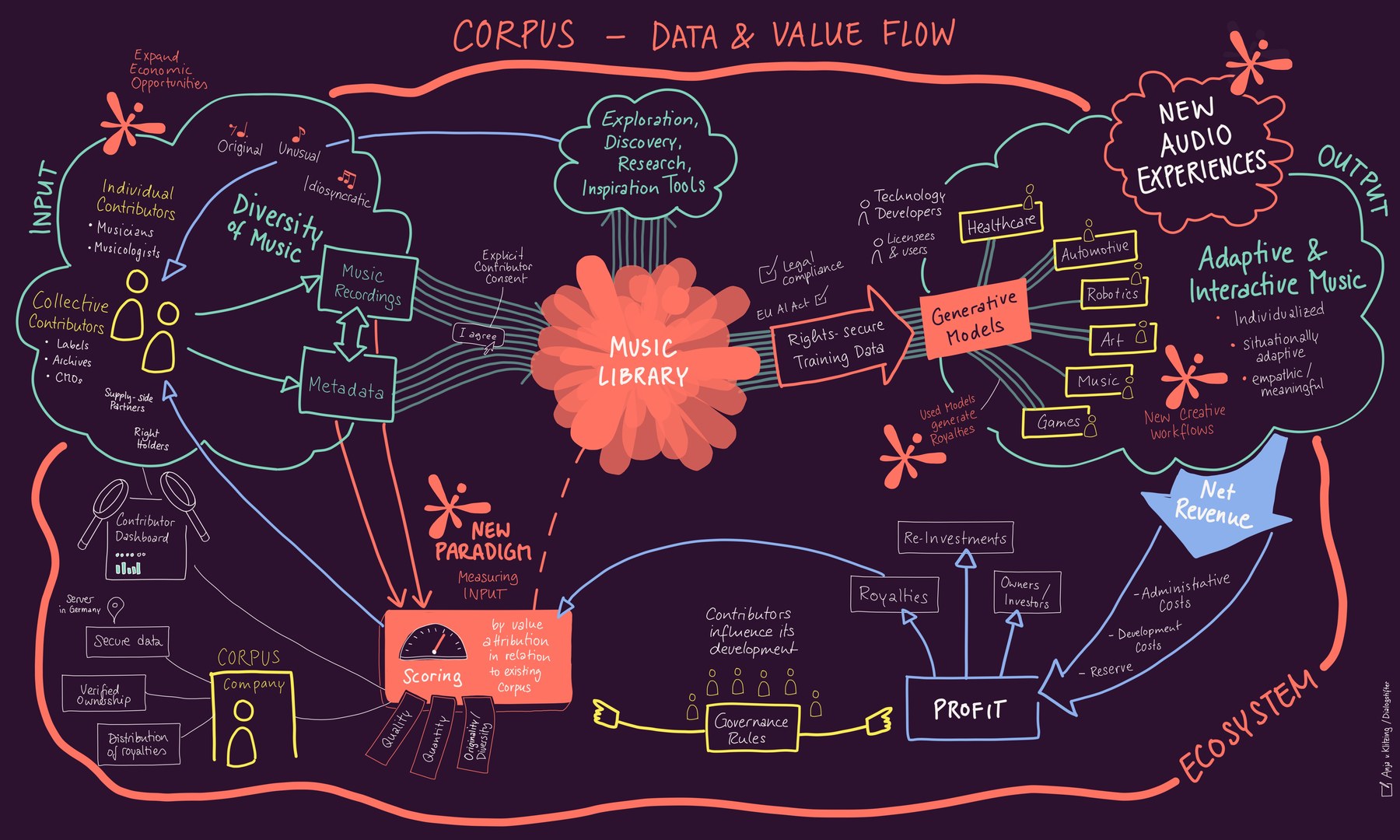
CORPUS is a licensing and royalty protocol that enables music creators to participate in the AI transition — not as suppliers to a system that extracts their work, but as co-owners of the infrastructure their contributions build.
What CORPUS is
- A licensing and royalty protocol. Music is licensed on the input side by explicit opt-in. Each work is evaluated for quantity, quality, and originality relative to the existing library. Originality is rewarded because it expands the expressive range of every model trained on the corpus.
- An open, auditable system. The scoring methodology, audit framework, and data standards are designed to be published and independently verifiable. See The Three-Layer Architecture.
- A protected corpus. The corpus never leaves CORPUS infrastructure. Licensees license CORPUS-trained models; a federated training path for custom architectures is under development. See Access Models.
- A dual currency. Contributors receive ongoing royalties and accumulate CRPS — Corpus Participation Rights, a lasting stake in the system their work builds.
- Infrastructure for new markets. The markets now emerging — adaptive sound in vehicles, therapeutic music in healthcare, responsive environments in games, semantic interaction in robotics, brand-sensitive advertising, cultural and educational deployment — require music that functions as situated experience, not as product. CORPUS is built to make these markets possible. See Applications.
What CORPUS is not
- Not a song generator. CORPUS does not compete with Suno, Udio, or any consumer-facing music-generation tool. The models it trains target contextual, application-specific deployment — not chart-style pop generation.
- Not a streaming service. Royalties are not tied to plays or consumption metrics. They follow downstream model usage, not stream counts. See How Royalties Flow.
- Not a major-label deal. A licensing agreement with a major catalogue solves a legal problem but leaves the verification problem untouched — you cannot read a training set off of model weights. CORPUS treats verification as a structural property of the system, not as a contractual attestation. The full argument is in Why CORPUS.
- Not designed to replace musicians. Models trained on CORPUS function as responsive collaborators in creative contexts and as engines for markets where music behaves rather than plays. The infrastructure is built so contributors share in what they help build.
Next: Who CORPUS Is For.