Three Modes of Search
CORPUS is being built in the open. Some of what you read here is live, some is still design intent — expect it to evolve.
People come to a music corpus knowing what they want in very different ways. A music supervisor with a brief might have a precise sound in mind. A composer might have a reference track and want something like it but darker. A director might have a scene and no idea what music it needs. A single search field treats all three the same; CORPUS treats them as different problems.
The demo at intelligence.corpus.music routes each query to one of three modes. The session locks to its mode so follow-ups stay coherent.
Precision search
For when you know the sound. The query becomes an explicit set of constraints — genres, moods, instruments, key, vocal treatment — and the corpus returns ranked tracks that match. Refinements ("more sparse", "no piano") update the constraints without leaving the mode.
"Dark jazz, no vocals, only piano, slow."
Best for: briefs with a clear sonic specification, A/B comparisons across known parameters, catalogue navigation by a user who already knows the space.

Audio similarity
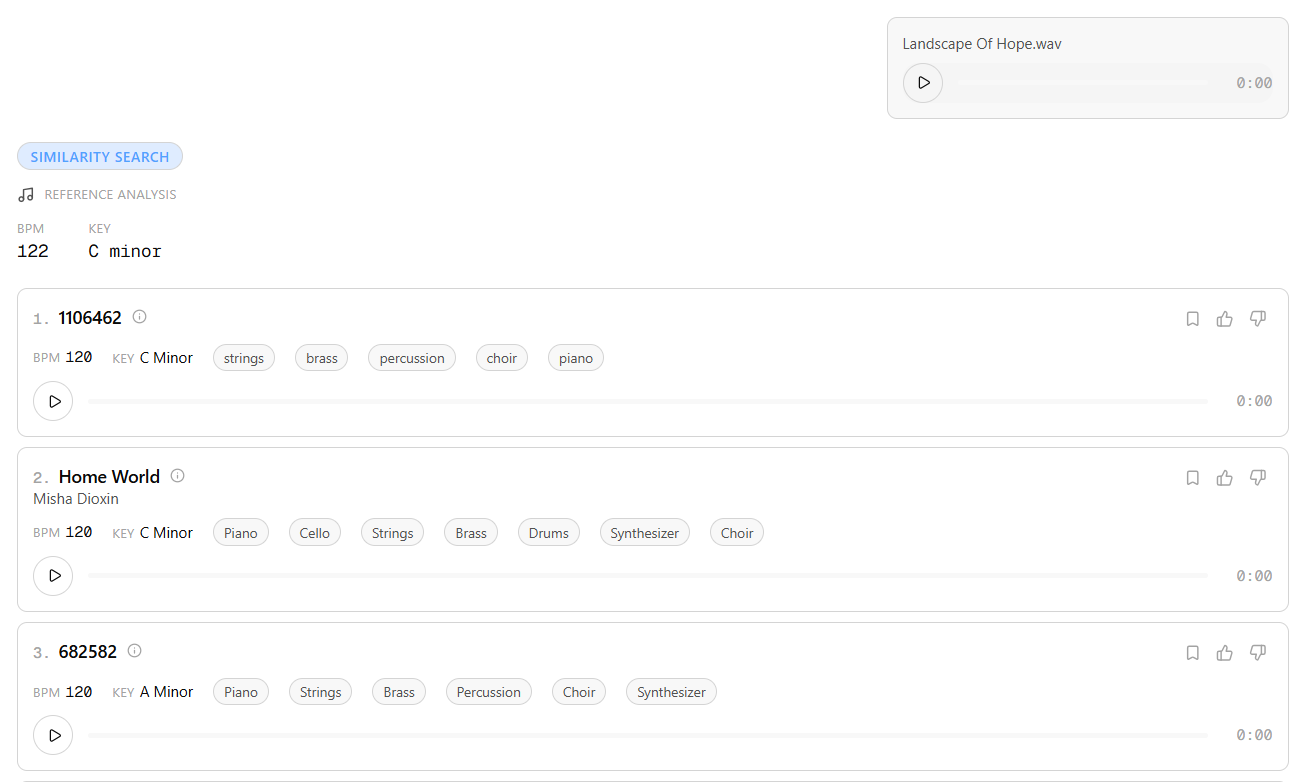
For when you have a reference. Upload a track — your own, a temp from an edit, a piece you wish you could license. The system analyses BPM, key, instrumentation, energy, and vocal treatment, then returns similar tracks from the corpus. Relative shifts work too: "similar but darker", "similar but at half tempo", "similar but instrumental".
Best for: replacing a temp track, finding alternatives to a piece you cannot clear, exploring a corner of the corpus anchored by a known example.
Story2Music — narrative search
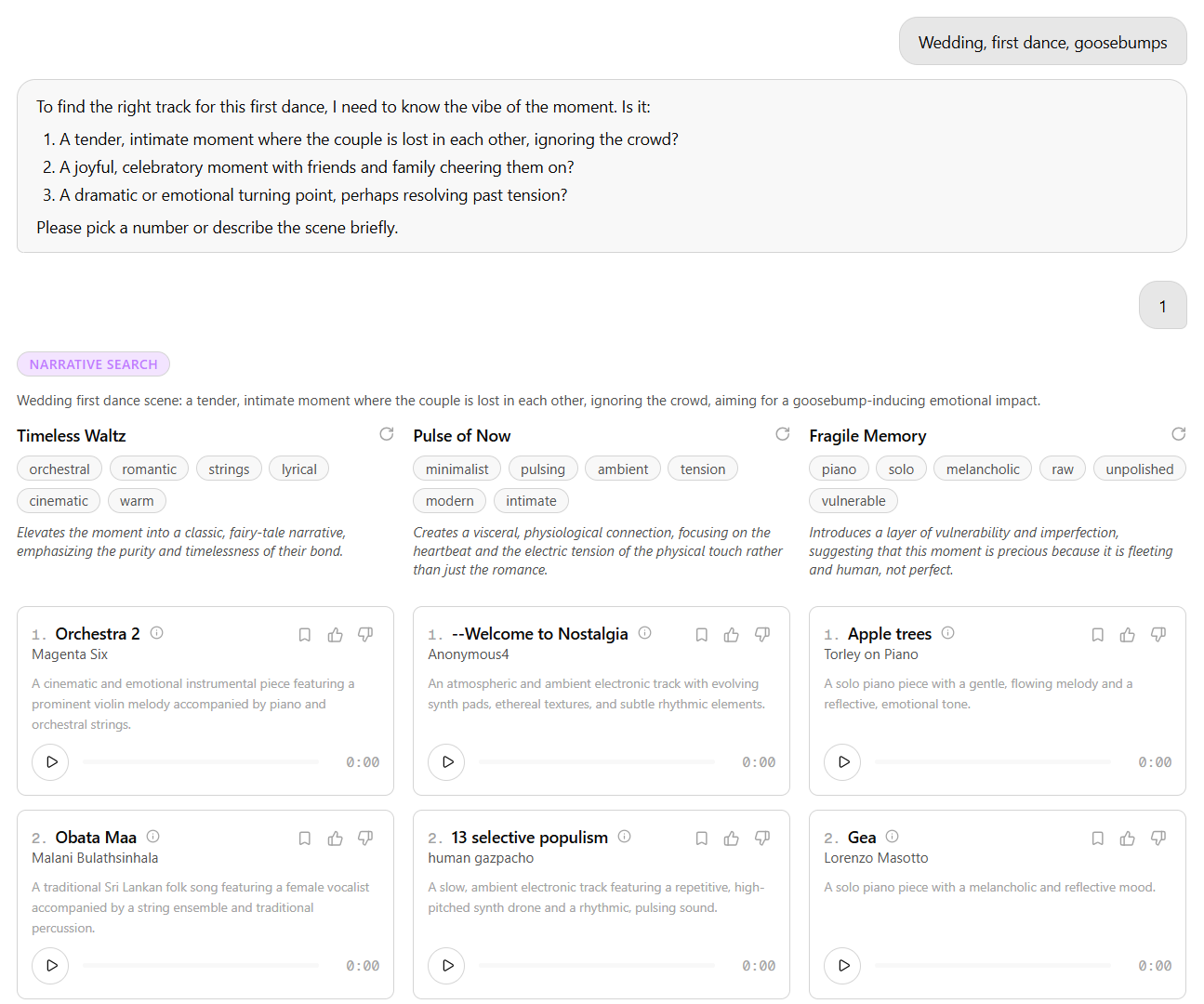
For when you have a scene, not a sound. Paste a screenplay excerpt, describe a beat in a film, sketch a moment in a game. The system reads the scene and returns three dramaturgically distinct directions, each with:
- a short title naming the direction,
- keywords describing the sonic and atmospheric character,
- a what it adds note explaining how the music transforms the scene,
- a semantic search query the system runs against the corpus to retrieve matching tracks.
The three directions are deliberately different from each other — orchestral tension versus stripped-down intimacy versus electronic propulsion, for example. The value of the mode is the contrast between them: readings of the scene the user would never have searched for on their own. Rejected directions are remembered so the system does not repeat them.
Best for: creative briefs without a fixed sound, early exploration in a film or game scoring process, finding music for a feeling that does not yet have a vocabulary.
Refinement carries memory
Across all three modes, refinements stay in the same session. "Make it more electronic" applied to a precision search updates the constraints; applied to a similarity search shifts the reference profile; applied to a narrative result generates a new direction without retreading the rejected one. The system tracks what the user has rejected so it does not loop.
What the corpus knows about each track — the dimensions all three modes query against — is in What CORPUS Knows About Each Track.