How Royalties Flow
CORPUS is being built in the open. Some of what you read here is live, some is still design intent — expect it to evolve.
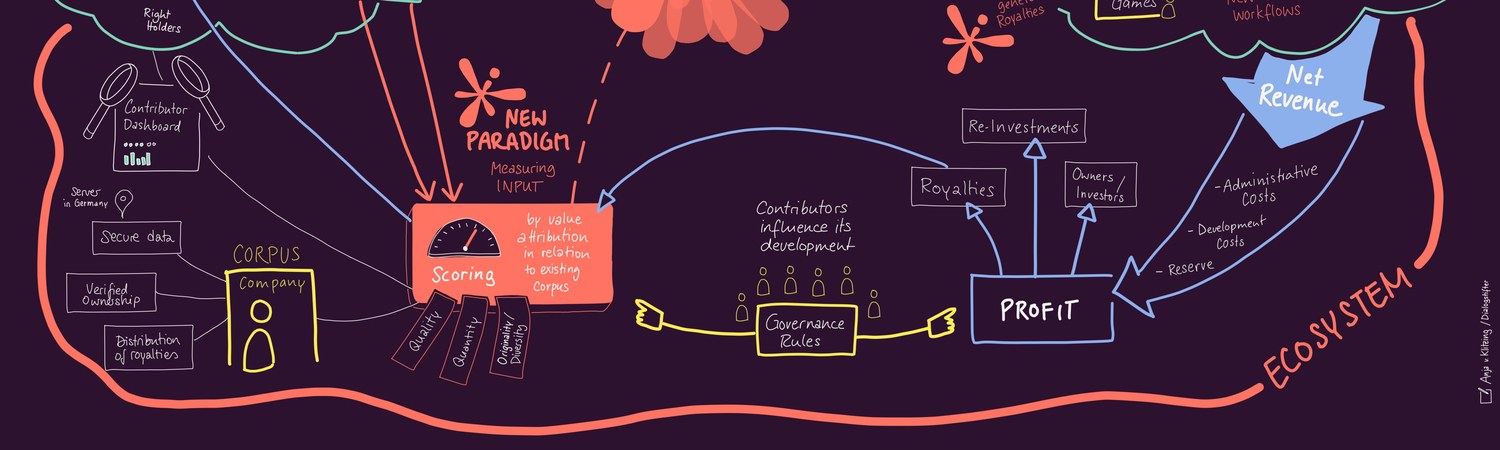
Contributor points translate into revenue shares through a transparent two-step process. Royalties are tied to the training stage: contributors are paid when their works form part of the dataset for a monetized model. The one defined exception is the Generative Output Bonus below.
Revenue pool and costs
All revenue from sublicensing and from CORPUS-owned products and tools flows into a central pool. A defined share covers infrastructure, legal, staff, R&D, and reserves for growth. The remaining net revenue forms the royalty base.
The split between operational costs and royalty pool is a governance parameter — set and adjusted by the scoring jury and constitutional track, not by the commercial entity alone.
Model-level attribution
Royalties are calculated per model, not per output. For each distribution round:
- Points per contributor are summed across all works included in that model.
- A global point total is calculated across all contributors in the model.
- Revenue is allocated proportionally.
Example. If Model A generates €1M net revenue, and Contributor X holds 0.5% of the model's total points, they receive €5,000.
The Generative Output Bonus
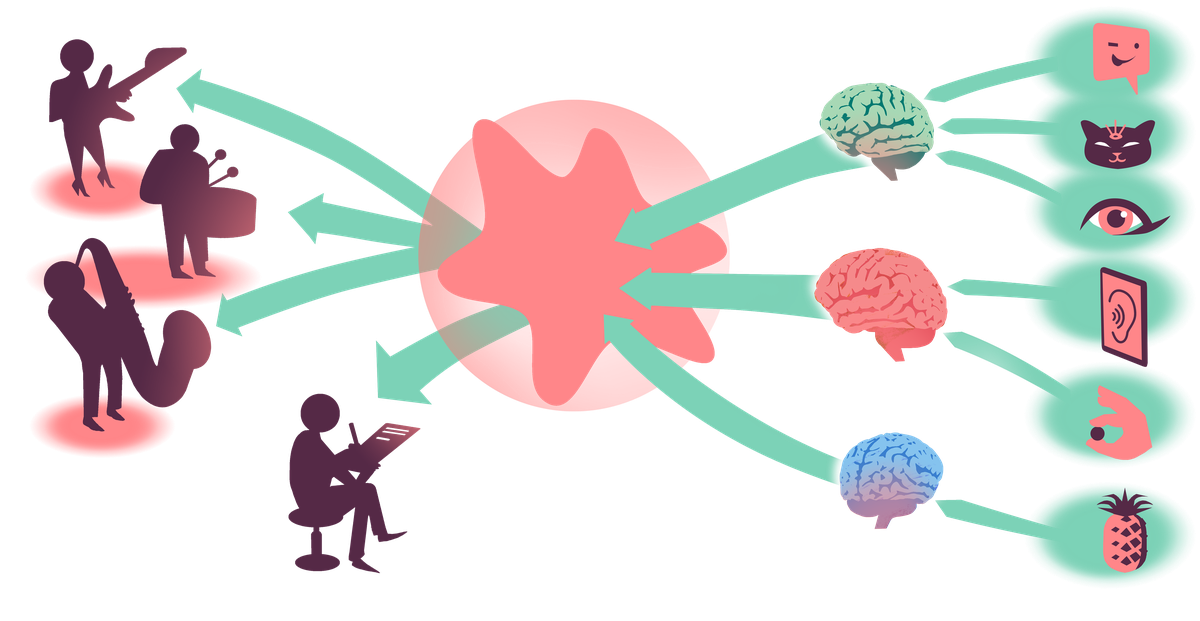
Where a generated output has an identifiable revenue — a track generated and sold through a CORPUS-licensed product, for example — a defined share of that revenue is distributed as a Generative Output Bonus: it goes to the contributors whose works occupy the sonic neighbourhood of the output, weighted by similarity to the output and by originality within the corpus. The remainder follows the model-level allocation above.
Two things define the bonus:
- It measures statistical proximity, logged per generation. Causal influence of a single work on a model output cannot be measured; nearest-neighbour similarity in the corpus can. The bonus is a defined allocation rule over that measurement, never a claim of causal attribution.
- Its legal basis is the contributor agreement. The payout follows from the agreement every contributor signs when joining. It implies no claim that the output copies or derives from anyone's work.
The size of the share, the similarity threshold, and the handling of subscription models without per-output revenue are parameters still being calibrated.
Across subsets and models
The corpus is sliced into subsets per application domain — a healthcare subset, a mobility subset, a games and XR subset — each tailored to the use case but drawing from the same shared library. A single contribution can sit in multiple subsets, and a single subset can feed multiple models.
Contributors are not compensated only once. They share in revenue every time a dataset or subset they're in is used to train a monetized model. Works that score highly but are not yet included in a monetized model remain eligible for future rounds — as new models are trained, those contributions may begin generating revenue. Value can be realized over time, not only at upload.
Distribution rounds
- Frequency. Initial payouts may be annual or quarterly, with frequency increasing as revenue grows. Small balances roll over to keep transaction costs down.
- KYC. Contributors complete Know-Your-Customer procedures before any payment.
- Invoicing. Each payout is accompanied by an invoice or credit note that the contributor can use in their own tax declaration.
The contributor-side view is on Your Dashboard: which works are included in monetized models, which remain pending, point balances, royalty shares, and payout history.
Oversight and disputes
Every financial flow is logged in tamper-evident records — the same append-only registry that backs the audit trail. Contributor-elected boards review reports, with external audits as the system matures.
Contributors can appeal point allocations, fraud flags, or payout calculations. Governance mechanisms define escalation steps and mediation. See Dispute Resolution.
Balancing complexity with usability
Any system that balances fairness with resistance to abuse will sound complex. CORPUS addresses this in two ways. First, complexity exists only where it increases fairness or prevents abuse — not where it obscures flows. Second, interfaces absorb the complexity: contributors do not need to understand the formulas (but they can if they want to); the dashboard shows which works, which models, which revenues, which payouts.
Royalties are one half of contributor participation. The other is CRPS — a lasting stake in the system the corpus builds.
Next: CRPS — Participation Rights.