Narrative Search
For when you know what you need music for, but not which music. Underneath it sits a deliberate stance.
Three readings, not one answer
CMI does not claim to know the right track for your scene. The assumption is the opposite: there are always several ways music could take a moment: each one colors the scene differently and pushes it somewhere else. Which to follow is an artistic choice, and it stays yours.
So CMI returns three distinct directions, each with example tracks and a note on what the music changes about the scene. The three are deliberately far apart (the range is wide, leaning only slightly toward commercial familiarity rather than the avant-garde) so you can hear how the same moment wants to go to very different places.
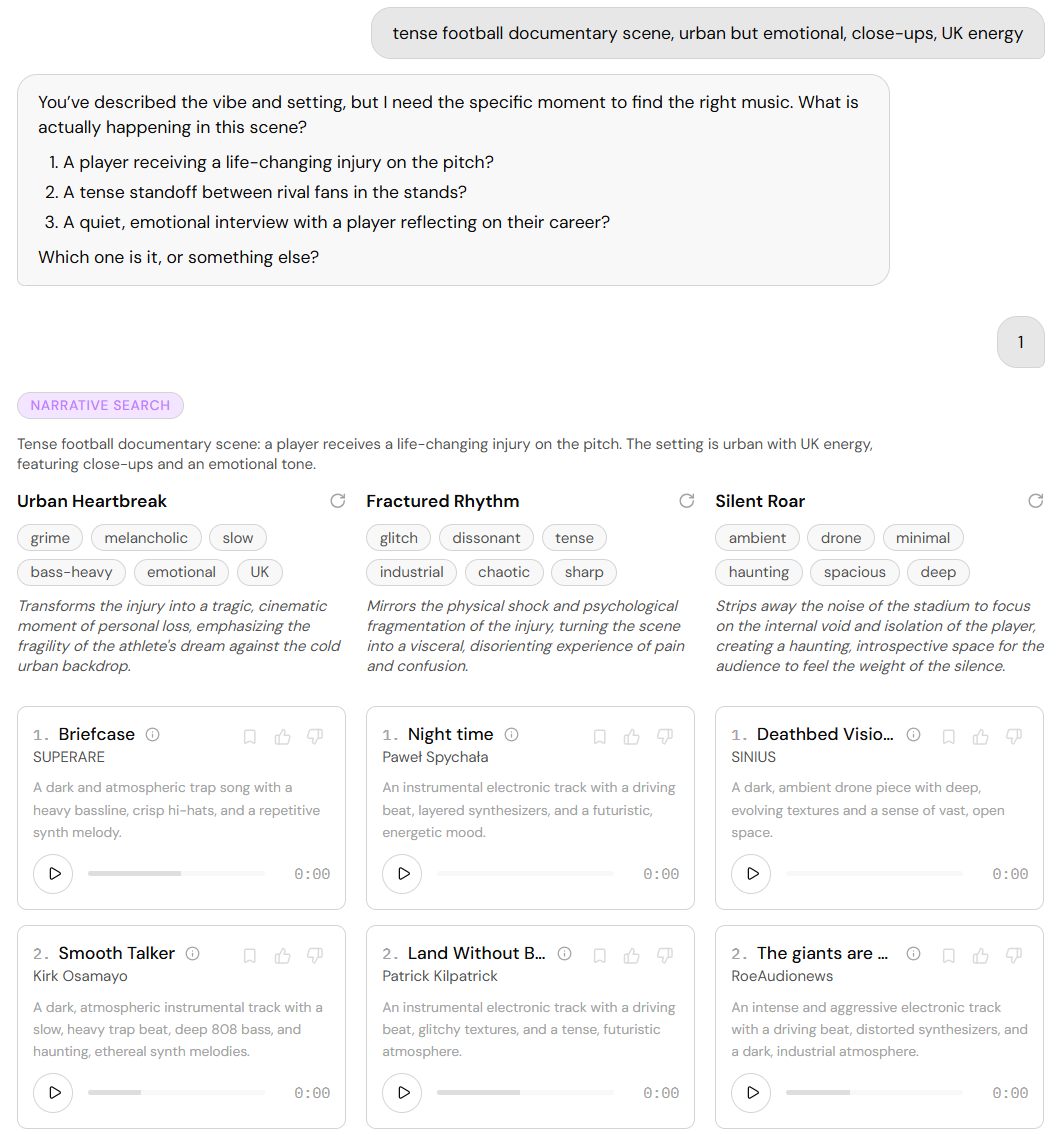
Describe the moment
- Text: a scene, a beat in a film, a feeling. "The moment she reads the letter and realizes he's gone."
- A photo or a video: upload it and CMI reads it for the decisive moment music would shape. Add a line or two of text alongside the media to steer how it reads the image.
Steer it
- Regenerate one direction. If a direction is off, hit the regenerate (↻) button at the top-right of that direction. Only that one is replaced; the other two stay.
- Constrain the field. Already know it has to be, say, a country or Americana sound? Say so and the three directions stay inside that lane (up front, or later as a refinement).
- Bring a temp. Working against a temp track you can't license, or aren't quite happy with? Hand it over and CMI opens alternatives: a way to think about what else the moment could become.
The concept behind the mode (Story2Music) is in Three Modes of Search.