How Your Music Is Evaluated
CORPUS is being built in the open. Some of what you read here is live, some is still design intent. Expect it to evolve.
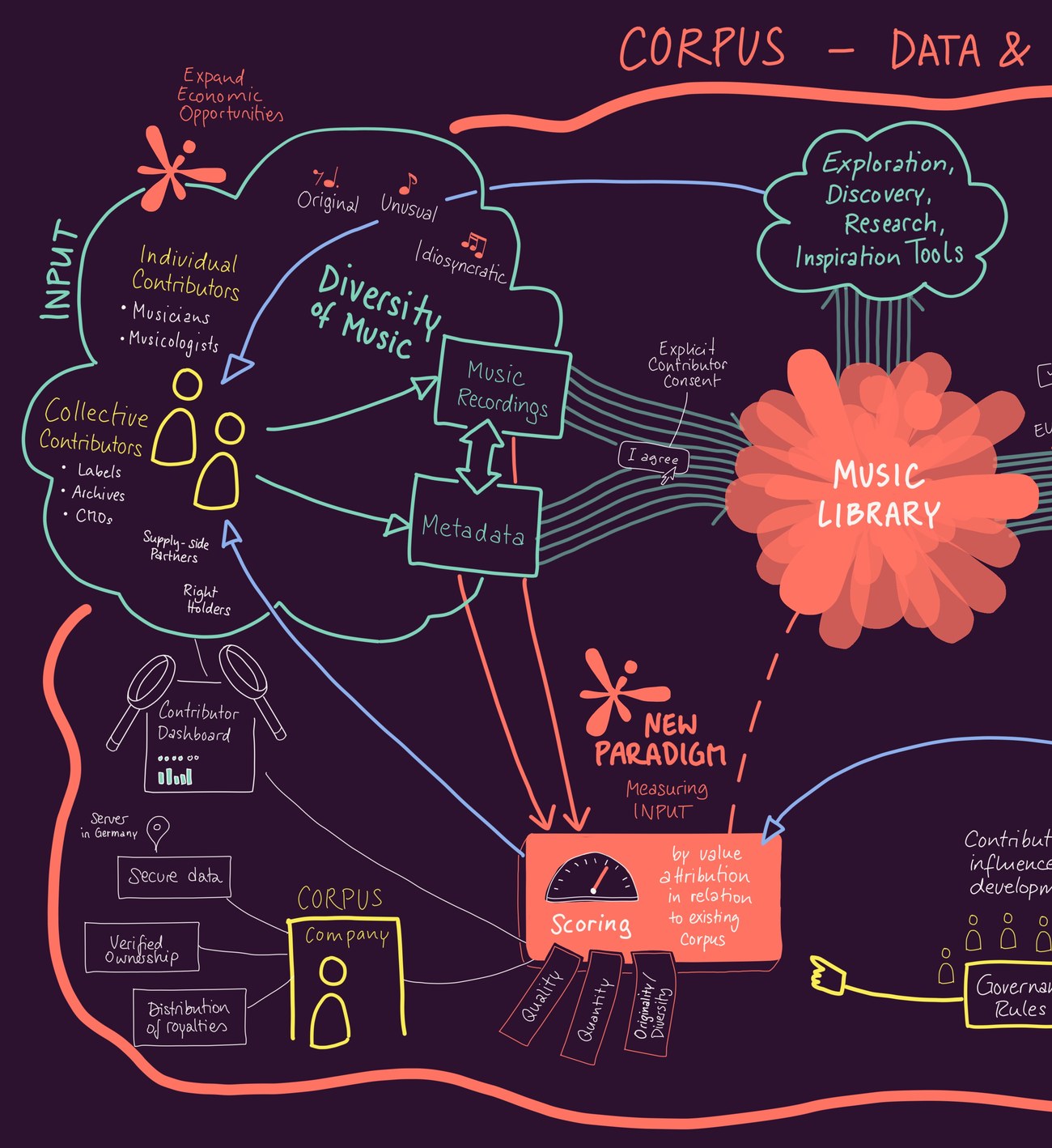
Unlike traditional licensing, where royalties follow the reproduction of finished works, CORPUS allocates value on the input side: every contribution receives a score that determines its share of royalties when models trained on the corpus generate revenue. A track is scored once, at ingest, against a versioned scoring policy; every score can be traced to the version that produced it. During the public beta, documented recalibrations can still shift scores across the corpus.
Three dimensions decide the weight: quantity, quality, and novelty. The points come from two sources: the measured technical quality of what you upload (20 to 110) and its novelty within the corpus (0 to 100). The three dimensions are the questions those points answer. Quantity: every accepted work earns its own score, and stems and MIDI earn more. Quality: the craft of the master is measured and paid in points, while the style-relative reading of your mix is described and deliberately unpaid, because the right yardstick depends on your intention, and intention cannot be measured. Novelty is how CORPUS pays for diversity. Full mechanics: The Scoring System in Detail.
Quantity: every accepted work counts
Participation is rewarded per work, not per upload volume. Only verified music counts: non-musical content, duplicates, uncleared covers, and AI-generated material are filtered before anything is scored, and missing vocal consent holds a track until it is on file. Each accepted work earns its own score; stems (10 points each, up to ten per track), MIDI files, and session data earn additional points on top, because they let models learn the individual elements of a production. Mass uploading buys nothing: the other two dimensions decide how much each work is worth.
Quality: measured in points, read in context
The technical quality of the master earns the base points, 20 to 110, from a forensic report of the audio itself. The measurement decides, not the file label: a lossless 24-bit master earns 100, genuine high-resolution material a bonus, a standard MP3 50. An MP3 repackaged as a WAV scores as an MP3. Real damage (clipping, bad resampling, heavy noise) reduces points by the training value it destroys; no scored file drops below 20. Details: Technical Quality.
The style-relative side of quality, how your mix sits against well-made records of its own kind, is read but not scored. CORPUS shows you this reading openly: which style pool your track was measured against, where the sound deviates, and what that means, in language a musician can use. It awards no points, because the comparison only makes sense against the style you were aiming for, and your intention is yours, not something a measurement can know. A deliberately raw mix is not a mistake. Details: The Sound Quality Reading.
Novelty: the diversity bonus (0–100)
The second point source, the most consequential dimension, and how CORPUS pays for diversity. Your track is compared as a whole against the reference corpus, and the score is a percentile: rarer than X percent of the corpus, X bonus points. An Anatolian bağlama recording may score high not because it is exotic but because the corpus does not yet hold anything like it. The reverse also holds: the tenth track that sounds like the nine before it earns less each time. Novelty cannot be farmed through volume. This inverts the streaming logic where the safest sound wins. A novelty score is protected for three years after ingest, then decays gradually toward a permanent floor of 30 percent. Details: Novelty Estimation and Temporal Dynamics.
What the score does not depend on
A few things scoring deliberately ignores:
- Genre popularity, chart performance, follower counts. None of these enter the score. The system is indifferent to commercial markers.
- Subjective taste. The scoring formula is the same for everyone, and the integrity decisions follow rules a contributor can appeal. Aesthetic judgment lives in the governance layer, not the algorithm.
- Who you are. Identity is verified during the application, but it does not affect the scoring of the work you upload afterward.
When the score changes
A score is fixed at ingest, with three exceptions: correction of an error or fraud flag (either direction), the novelty decay after its three-year protection, and, during the beta, documented recalibrations of the scoring policy itself. Royalty distributions use these scores each round; see Your Dashboard for what you can see of this, and How Royalties Flow for the math behind the share calculation.